Garage Door Repair: Repair or Replace? How Lawrence Homeowners Decide
Most Lawrence homeowners decide with their gut, and the gut is usually wrong. A door that has needed three repairs in two years feels like a money pit, so you replace it; a door on its second spring feels solid, so you keep patching it. Both calls ignore the number that actually matters: the cost per remaining year of service. This guide gives you the thresholds, the resale context for the Merrimack Valley, and a calculation you can run on your own door tonight.
If you’d rather have a specialist look at it than work it out on paper, call (855) 761-3321. Estimates are free, and we’ll tell you honestly if the answer is repair.
Why the “Three Repairs” Rule Misleads Lawrence Homeowners
Here’s our short answer: on a door under 15 years old, repair almost always wins. On a door over 15, the failure of a torsion spring, cable, or opener should trigger a full component audit rather than a single repair. The repair itself is fine. The problem is what’s coming next.
Picture a 20-year-old steel door with a snapped spring. A single-spring replacement runs roughly $180 to $340 depending on the door’s weight and the spring setup. Most doors run a matched pair, and pairs are usually replaced together, so budget about twice that. It feels like a reasonable fix.
But the cables, rollers, bearings, and bottom seal on that door are the same age as the spring that just failed. They’ve cycled the same number of times and lived through the same Lawrence winters. In our experience, once one high-cycle component goes on a door that old, the others tend to follow within about 18 months. Three staged visits later, you’ve spent close to what a new door costs, and you still own a 22-year-old door.
That’s the case for auditing the whole system at the first sign of failure, not waiting for the dominoes.
- Springs: expect 8 to 12 years of life on a standard cycle count
- Cables: typically 10 to 15 years before fraying or stretching
- Rollers: 5 to 10 years, faster if the door has never been lubricated
- Openers: 10 to 15 years before the logic board or drive gear gives out
- Bottom seal and weatherstripping: 5 to 8 years against New England freeze-thaw
What Garage Door Replacement Actually Returns in Lawrence
Garage door replacement is consistently one of the highest-return exterior projects in national remodeling cost-versus-value data, and the Merrimack Valley doesn’t break that pattern. In Lawrence’s housing stock, though, the return depends heavily on matching the door to the neighborhood, not on buying the most expensive model.
Lawrence is dominated by triple-deckers, two-family homes, and older single-families with detached or attached garages that were often added decades after the house was built. In those settings, a steel raised-panel door in a color that matches the trim does more for curb appeal, and for the appraisal conversation, than a carriage-house door with decorative hardware that fights the house’s style. If you’re in a neighborhood of restored Victorians and colonials, a stamped carriage-style door (Clopay and Amarr both make profiles that suit that look) earns its cost. On a triple-decker with a plain concrete apron, it usually doesn’t.
What we tell homeowners weighing resale: a new door raises perceived condition, which matters more than any single line item on an appraisal. A door that’s dented, faded, or visibly sagging reads as deferred maintenance to a buyer, and buyers price that in. But if you’re selling in the next year or two and the existing door is sound, a repair plus fresh paint gets you most of the way for a fraction of the cost.
The Structural Threshold: Damage That Makes Repair Irrational
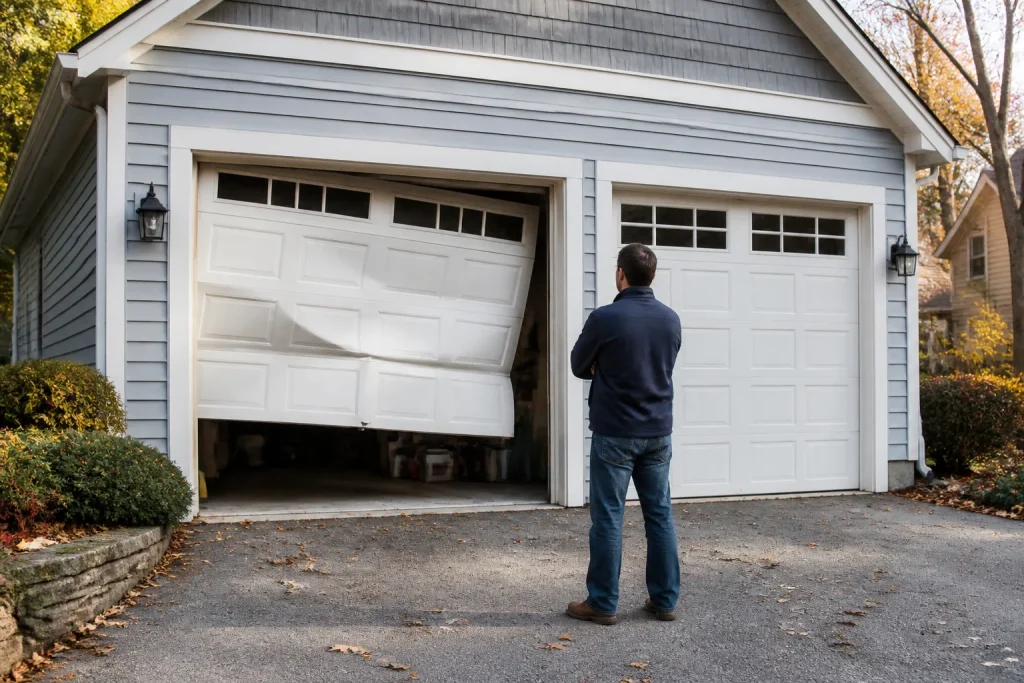
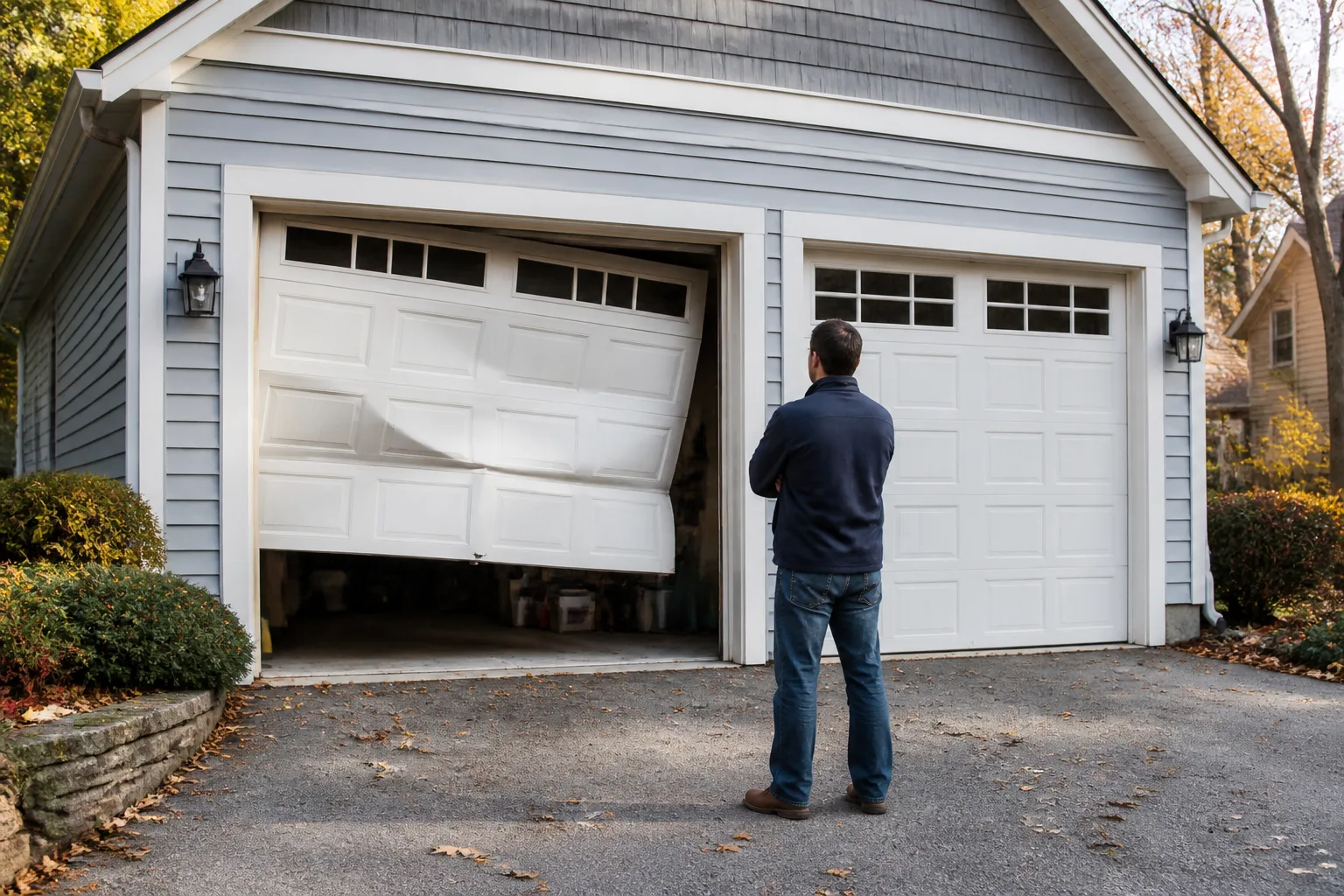
Some damage overrides the age math entirely. If you see any of the following, replacing the door is the rational call even on a door that’s only a few years old, because the cost of making the door structurally true again exceeds the cost of a new one.
- Multiple bent or creased panels. A single panel can sometimes be swapped, but on most current models panel-by-panel replacement is expensive and color-matching older finishes is unreliable. Two or three damaged panels usually tips the math toward replacement.
- Rust-through on the bottom section. Lawrence’s freeze-thaw cycles and road salt tracked onto the apron punish the bottom panel. Surface rust is cosmetic. Rust that has eaten through the steel near the bottom seal means water is sitting inside the door’s skin, and that panel is done.
- Deformed or bowed vertical tracks. Tracks that have been hit and bent back rarely return to true. A door that runs on deformed tracks wears every other component faster, and the misalignment will keep coming back.
- Sagging or cracked hinge-point steel. When the door’s internal structure is compromised, no amount of roller or hinge replacement will make it run smoothly and safely.
One safety note worth stating plainly: torsion springs and the cables under tension are the genuinely dangerous parts of this system. A trained technician with the right winding bars can handle them safely. A homeowner with a ladder and a pair of vice grips risks serious injury. We’d rather you call than improvise. If that’s where you are, our garage door spring repair page covers what the diagnosis and fix involve.
How to Calculate Cost-Per-Year: A Walkthrough
Here’s the calculation we run ourselves, and you can run it too.
Step one: estimate remaining life. Take the door’s rough age from its purchase date (check the original paperwork, or look for a manufacturer label inside the door). If it’s 12 years old and you expect 25 to 30 years total from a steel door that’s maintained, you’ve got roughly 13 to 18 years left.
Step two: total the repairs you’ve paid for and expect to pay. Look at your repair history. Add the current quote plus a realistic allowance for the components that age alongside the one that failed.
Step three: divide. If a full audit-and-repair runs $900 and buys you another 12 years of solid service, that’s about $75 per year. A new door with installation in this market generally lands in the low thousands, and spread over 25 years works out to a similar annual figure but with the higher upfront outlay.
Step four: factor in R-value. If your garage sits under living space, or you’ve insulated and finished the room above it, the door’s thermal rating matters. A tired single-layer steel door with a worn seal leaks heat all winter. When the R-value gap is meaningful, an energy-conscious replacement can make the cost-per-year math favor replacing, even when the door is structurally fine. Check what insulation rating your current door actually carries before you decide.
The honest takeaway: the number tells you which side of the line you’re on. Most doors under 15 years old land on repair. Most doors past 20 with a string of repairs land on replace.
When the Opener Changes the Math
This is the factor most homeowners miss. A door that’s worth repairing becomes worth replacing when the opener is also near end-of-life, because new door installation resets the entire system at once, and an installed door and opener together cost less than replacing them separately two or three years apart.
If your opener is a LiftMaster, Chamberlain, Genie, or Craftsman unit that’s 10 to 15 years old and already showing symptoms like reversing randomly, straining to lift, or losing its travel limits, that’s a signal. The drive gear, logic board, and belt or chain are all aging on the same clock as the door. Repairing the door now and replacing the opener next year means paying for two installations and two service calls.
We work on the legacy mechanical openers and the modern smart units alike, so we can tell you plainly whether your existing opener has years left or is on its way out. If the opener is healthy, we’ll say so, and our garage door opener repair page covers what a targeted fix looks like. Replacement of a functioning opener when the door is sound is an upsell, and we don’t push it.
When to Call a Pro
If the door won’t open, is off-track, has a snapped spring, or drops faster than it should close, stop operating it and call. Running a door with a broken spring strains the opener and can turn a $300 fix into a motor replacement. If you’re unsure whether you’re looking at a repair or a replacement, that’s exactly the diagnosis a specialist can do in a single visit. As part of the Lawrence Garage Door Repair Pros team, we work on Chamberlain, Genie, Clopay, and Amarr equipment, among others, so we’re diagnosing your specific door and opener rather than steering you toward what’s easiest to sell.
Related services in Lawrence: garage door repair and spring repair for doors that are still worth keeping in service.
Key Takeaways
- On doors under 15 years old, repair is almost always the right call.
- On doors over 15, treat a single spring or cable failure as a cue to audit every component.
- Bent panels, rust-through, or deformed tracks make replacement rational regardless of age.
- Run the cost-per-year math: repair cost divided by remaining years versus replacement cost divided by new-door life.
- An aging opener can flip the decision, because replacing door and opener together is cheaper than two separate installs.
The Bottom Line
The repair-versus-replace question comes down to two numbers: the cost per remaining year of the door you have, and what replacement actually gets you in your Lawrence neighborhood. Repair first when the door has life left and the opener is healthy. Replace when cumulative repairs plus an aging opener would total more than a new system, or when structural damage makes the door unsafe or economically irrational to fix. If you’re in Lawrence and need help, Lawrence Garage Door Repair Pros offers free estimates. Call (855) 761-3321 and we’ll give you a written price before any work starts. Our technicians have up to 10 years of experience, and our quotes don’t move after we’ve seen the job.
Frequently Asked Questions
Repair is cheaper in the short term almost every time, but the full comparison depends on the door’s age and repair history. On a door under 15 years old with one failed component, repair typically runs a fraction of replacement cost. On a door over 20 with a history of repairs, cumulative costs often approach replacement within a few years. Run the cost-per-year math before deciding, and call (855) 761-3321 for a free written estimate on either path.
Standard torsion springs typically last 8 to 12 years, though cycle count matters more than calendar time. A door used a few times a day will see springs last longer than one cycling constantly in a busy household. Lawrence’s temperature swings and road salt don’t help the steel, so springs past 10 years are on borrowed time. If a spring has snapped, call us for a diagnosis rather than operating the door.
You technically can, but it’s rarely wise. Paired springs on a torsion system share the load and were wound to match. Replacing one while its partner carries the same age and wear tends to lead to a second failure soon after, which is why pairs are usually replaced together. That means a pair costs roughly twice a single-spring price. Call (855) 761-3321 and we’ll quote the correct setup for your door.
A new garage door is consistently among the stronger exterior returns in remodeling cost-versus-value data, and in Lawrence’s market the return hinges on matching the door’s style to the housing stock. A steel raised-panel door in a trim-matching color suits the triple-deckers and two-families that dominate the city and reads well to buyers. A more elaborate carriage-style door only pays off when the house’s architecture supports it. For a free estimate on whether repair or replacement makes sense, call (855) 761-3321.
Written by the team at Lawrence Garage Door Repair Pros.
Need Garage Door Help?
Call Lawrence Garage Door Repair Pros - the local pro we connect you with is licensed and insured, here with fast after-hours help in Lawrence.
(855) 761-3321