Top Signs You Need Garage Door Service – Don’t Ignore These
Most garage door failures don’t arrive without warning. They broadcast mechanical signals days or weeks ahead, and the reason homeowners miss them is simple: the door still opens, so it must be fine. It isn’t. A garage door that opens unevenly by even half an inch is often running on a broken spring while the second one does the work of two, and plenty of people keep pressing the button until that second spring lets go and the door drops. This piece is about reading the warnings early. If you’d rather not crawl around the tracks with a flashlight, call (855) 761-3321 and we’ll take a look.
The Asymmetry Test: How to Spot a Dying Spring in 30 Seconds
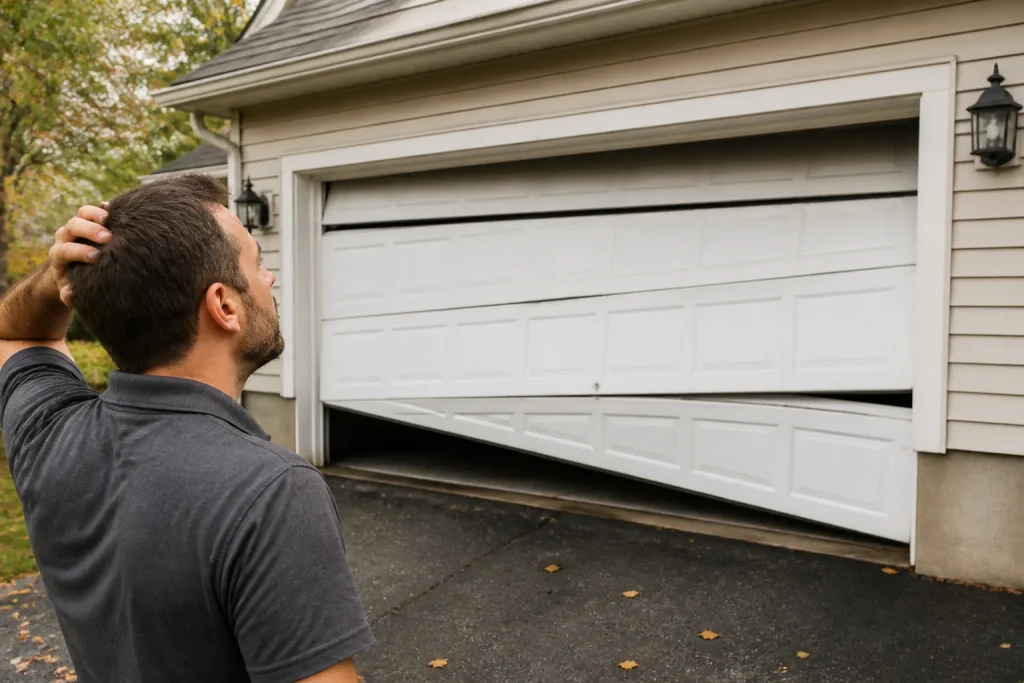
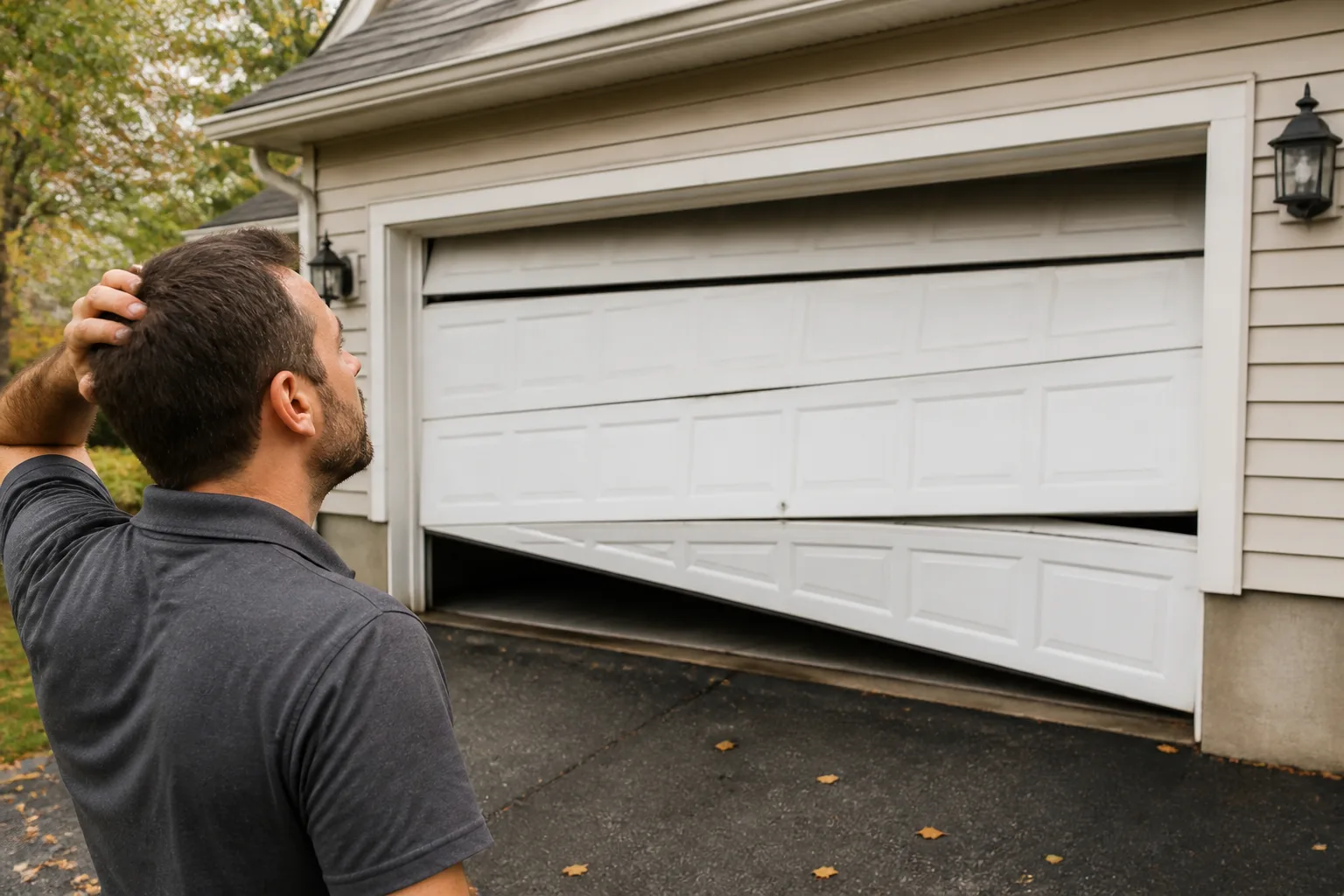
Stand in the driveway, press the button, and watch the top panel rise. The gap between the top of the door and the header should stay level across the full width. If one side lags even a little, that’s your first sign. A torsion spring that has lost tension or cracked on one side lets the opposite side carry more load, and the door tilts like a table with one short leg. Extension springs show it differently: one spring stretches longer than the other as the door goes up, or hangs limp while its partner is still coiled.
This matters because a matched pair of springs is a system. Once one fails, the survivor is working outside its design load, and the failure that follows is faster and louder. That’s the moment when a door can slam down instead of easing shut.
Two more visual checks anyone can do in Lawrence:
- Look at the spring above the door. Gaps in a torsion coil or a visible kink mean it’s done.
- Check the cables on each side. Slack or a frayed end on one side warns of a load imbalance.
Don’t touch the springs or cables to test them. Torsion springs hold serious stored energy, and a winding bar slipping loose in untrained hands is how people get hurt. Our technicians have up to 10 years of experience on exactly this, so if the asymmetry looks real, leave it to a pro.
What That Grinding, Popping, or Squealing Is Actually Telling You
Sound is the cheapest diagnostic tool you own, and “it just needs oil” is the most overused answer in the trade. Each noise maps to a specific part, and Lawrence homeowners who learn the difference save themselves a bigger repair.
- Grinding that rises and falls with door travel: worn or dry rollers, or rollers that have flat-spotted. Sometimes the hinge pivots are binding.
- A sharp pop when the door starts or stops: a torsion spring slipping on its shaft, a loose drum, or a hinge plate pulling free of the panel.
- A high squeal during motion: metal-on-metal contact where it doesn’t belong, often a bent track rubbing the edge of a roller.
- Clunking right after the opener engages: slack in the drive belt or chain, or a worn gear inside the motor housing.
- Rhythmic scraping from the bottom: the bottom seal dragging because a panel is out of line.
A single short squeak after a wet stretch in Lawrence is often just friction. A grinding that shows up every single cycle and keeps getting louder is telling you a part is wearing toward failure. If any of these sounds show up alongside an uneven lift, treat it as one problem and book garage door repair before it strands a car.
Why Your Door Reverses Before It Hits the Floor
A door that goes back up a few inches off the ground is usually tripping its safety sensors, not failing to close. The fix is sometimes as small as a sensor knocked out of alignment by a broom handle or a recycling bin. But not always, and the difference is worth knowing.
Here’s how to tell:
- Sensor problem: the indicator light on one sensor is off, blinking, or a different color than its partner. The door reverses at the same height every time. Clear the lens and straighten the brackets so both eyes face each other.
- Travel limit problem: the door reverses at a random height or right as it reaches the floor, and the sensors look fine and lit. The opener’s limit setting has drifted.
- Bent track: the door reverses at slightly different spots, and you can see the vertical track pulled out of line where a panel edge catches. Look at the track as the door comes down; the roller should ride smoothly, not bump.
If the sensors are lit and aligned and the door still reverses, stop pressing the button. That’s an opener logic or travel problem, and it’s the kind of thing garage door opener repair handles properly, whether you’re on a LiftMaster, a Chamberlain, or a Genie.
The Response-Lag Warning Most People Blame on the Remote
Press the button and count. A healthy opener begins moving the door within about a second or less. When the motor sits there for more than two seconds before the door budges, that’s a motor stress indicator, not a dying remote battery. The remote sent its signal fine; the machine at the other end is hesitating.
Common causes:
- A binding door. The opener is fighting a door that’s harder to move than it should be. Worn rollers, a dry torsion system, or a warped panel add resistance, and the motor can’t beat physics.
- A failing capacitor or worn drive gears. The motor spins up weakly, or the belt slips before it grabs.
- A logic board under strain. On smart openers (LiftMaster and Chamberlain models with Wi-Fi, for example), a board that’s aging or getting poor signal can add a pause.
Try a fresh remote battery first. If the lag survives that, the opener itself needs a look. Left alone, that hesitation tends to grow into a motor that won’t start at all. We work on legacy mechanical units and modern app-connected systems alike, so the model in Lawrence garages doesn’t limit what we can fix.
Weatherstripping Gaps: The First Sign of a Warped Panel
That thin line of daylight under a closed garage door doesn’t always mean the seal is old. Run a hand along the bottom of the door while it’s shut and feel for spots where the rubber no longer touches the floor. If the gap runs the full width, the seal or its retainer is worn. If it’s uneven, thicker at one side, you’re looking at a warped or bent door section.
Why a warped panel matters more than a draft: a panel that has twisted is holding the rest of the door out of square. As the door travels, that misalignment grinds rollers against the track, strains the hinges, and loads the springs unevenly. In Lawrence winters, moisture and temperature swings work on door sections from the inside as well as the outside, and a small warp tends to grow. A slightly out-of-line Clopay or Amarr panel might only need a realignment; a badly bent one is a different conversation. Either way, catching it while it’s just a gap is the point.
When to Call a Pro
Change the remote battery, clear the sensor lenses, and look at the door while it moves. That’s your DIY lane. Anything involving the springs, the cables, the torsion shaft, or the opener’s internal parts belongs to a trained technician, and no flashlight test changes that. If your door is tilting as it rises, if it’s making a noise that’s getting louder, or if it’s reversing without an obvious cause, call it in. Franklin and Andover homeowners pass through Lawrence with the same symptoms every week, and it never pays to ignore them.
For the springs themselves, that’s garage door spring repair. For a motor that’s stalling or hesitating, it’s the opener. If you’re not sure which you’re dealing with, a diagnosis sorts that out.
Related services in Lawrence: garage door repair, opener repair, and spring repair, all handled by one specialist who works on the brands already in your garage.
The Bottom Line
Most garage door failures announce themselves first: an uneven lift, a grind that won’t quit, a door that reverses just shy of the floor, a two-second lag on the button, or daylight under the seal. Listen to those signals early and you turn a risk into a small repair. Ignore them and you’re waiting on the loud version.
If you’re in Lawrence and need help, Lawrence Garage Door Repair Pros offers free estimates, and the price is quoted and agreed before any work starts. Call (855) 761-3321 to get your door looked at. The rest of our site, at Lawrence Garage Door Repair Pros, covers what we repair and the brands we handle.
Frequently Asked Questions
Uneven lifting, unusual grinding or popping sounds, a door that reverses before reaching the floor, a delayed response from the opener, and gaps in the bottom weatherstripping. Each points to a specific component, which is why a technician checks them together rather than guessing.
For a while, yes, and that’s what makes it dangerous. The surviving spring carries the extra weight, the door lifts unevenly, and the second spring fails sooner because of it. A door operating with a broken or weakened spring should be left closed until it’s repaired.
Sensors, remotes, and visual checks are fine to handle yourself. Springs, cables, and opener internals are not, because the stored tension in a torsion system can cause serious injury without warning. Confirm the quote and call a trained technician before you touch the springs.
No. A sensor knocked out of alignment is the most common cause, but a bent vertical track, a drifted travel limit, or an opener logic issue can produce the same reversal. Check that both sensors are lit and facing each other first; if they’re fine, the cause is elsewhere and worth a professional diagnosis.
Written by the team at Lawrence Garage Door Repair Pros.
Need Garage Door Help?
Call Lawrence Garage Door Repair Pros - the local pro we connect you with is licensed and insured, here with fast after-hours help in Lawrence.
(855) 761-3321